


Milk delivery challenge for dairy farmers in West Pokot
Susana, 53, is a dairy farmer from Kaptabuk, West Pokot county in Kenya. She sells her milk to the Kaptabuk milk co-operative where she has been a member since 1994. Every day at around 5:00 am, Susana would walk 3 kilometres from her home to the co-operative to deliver milk. Sometimes, the journey would take too long – the milk would spoil and therefore be rejected by the cooperative. As Susana got older she found the journey more physically difficult, however as this was her only source of livelihood Susana accepted the transport challenges and frequent post-harvest losses.
According to IFAD (International Fund for Agricultural Development), at least 800,000 smallholder farmers in Kenya depend on dairy farming for their livelihood. Dairy production improves household nutrition and provides extra income. In addition to family labour, dairy farming generates jobs in wage labour and mobile milk trading for a further 365,000 people. These jobs benefit the poorest people in urban and rural areas. However, for the dairy farmers in Kaptabuk, milk delivery is a daunting challenge due to the long distances covered when delivering milk to their local milk co-operative.
Savanna Circuit provides a solution to reduce post-harvest losses
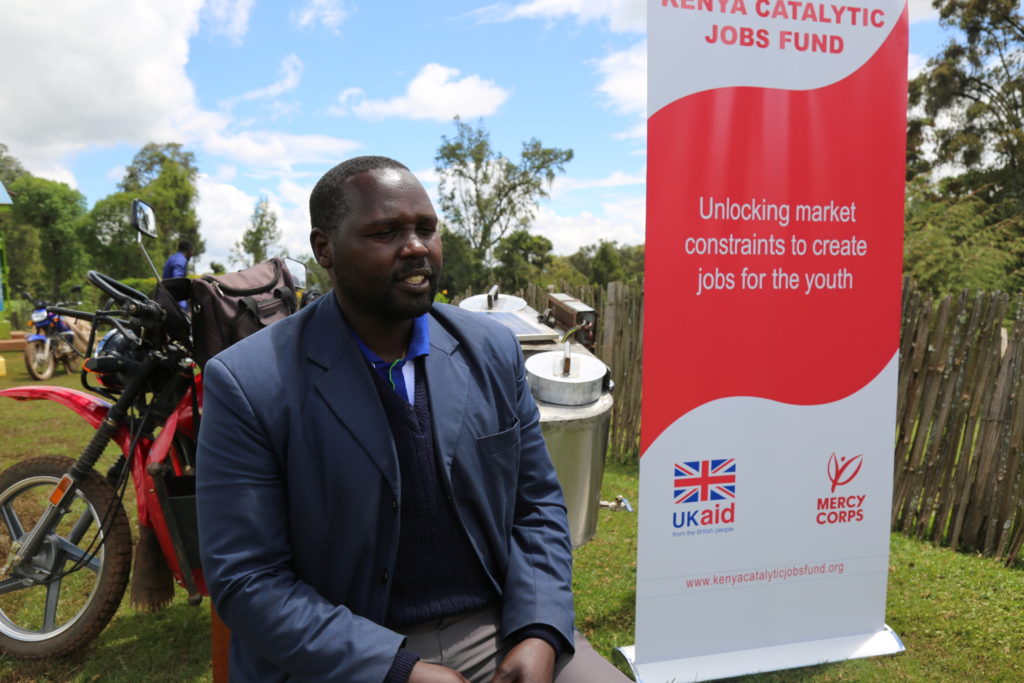
Susanna was approached by Percy Lemtukei, the Co-Founder of Savanna Circuit with a proposed solution to her milk transportation challenges. Savanna Circuit is an engineering and IT service solution provider. The company has developed the MaziwaPlus Pre-Chiller – a mobile, solar-powered chilling in-transit system that can be mounted on a motorbike or a tricycle, offering quality control, traceability, and maximized profits for both dairy producers and cooperatives. Following product development, Savanna Circuit approached the Kaptabuk Farmers’ Co-operative Society to propose trials of the MaziwaPlus Pre-Chiller and with their endorsement, they began reaching out to farmers like Susana.
As a result of using MaziwaPlus, Susana is no longer worried about getting her milk to the co-operative in good time. Savanna Circuit trained her on how to maintain the hygiene of her milk delivery containers to minimize rejections at the co-operative. Additionally, Savanna Circuit advised her to maintain two sets of milk containers to ensure that they are always well cleaned and dry before using them for milk delivery. Every day after her milk is collected, Susanna receives an SMS confirming the amount of milk delivered which enables her to update her milk delivery records remotely.
A big win for co-operatives as cost of energy reduces
The biggest beneficiary of Savanna Circuit’s innovation is Kaptabuk Co-operative Society. The co-operative’s chairman Reuben, noted that as a result of this innovation, the co-operative is able to reduce cases of milk spoilage and delayed delivery. They have also saved on the operational electricity cost for their coolers since the milk now arrives at a temperature of 7 degrees – down from the previous 24 degrees which has reduced the cooling duration. Savanna Circuit’s tracking app has also helped the co-operative to monitor collection volumes on a daily basis and make short-term predictions on collection volumes. Additionally, the app has assisted them to investigate and respond to farmers’ complaints/inquiries.
Savanna Circuit scales their innovation to support more farmers
With the support of the DIFD-funded Kenya Catalytic Jobs Fund, Savanna Circuit is continually innovating and improving its model through the recent introduction of milk chilling units mounted on a tricycle (tuk tuk). Holding up to 800 litres of milk, the new solar-powered units will cool the milk to a temperature of 6 degrees, an improvement from the previous 7 degrees. With the improved MaziwaPlus Pre-chiller unit, Savanna Circuit can cater to the growing market of smallholder dairy farmers in Kenya and reduce post-harvest losses.
Leave a Reply